We've seen persistent assertions on darknet forums claiming Monero offers total immunity from law enforcement tracking. Mark T., 34, from Florida, believed that narrative when he paid $480 in Monero for half a dozen cloned debit cards that included the necessary PIN codes in November 2024. He managed to pull $4,200 from three different ATMs. The fourth machine, though, recorded 23 seconds of high-definition facial video through its integrated camera—footage that became the prosecution's primary evidence and led to 60 months behind bars.
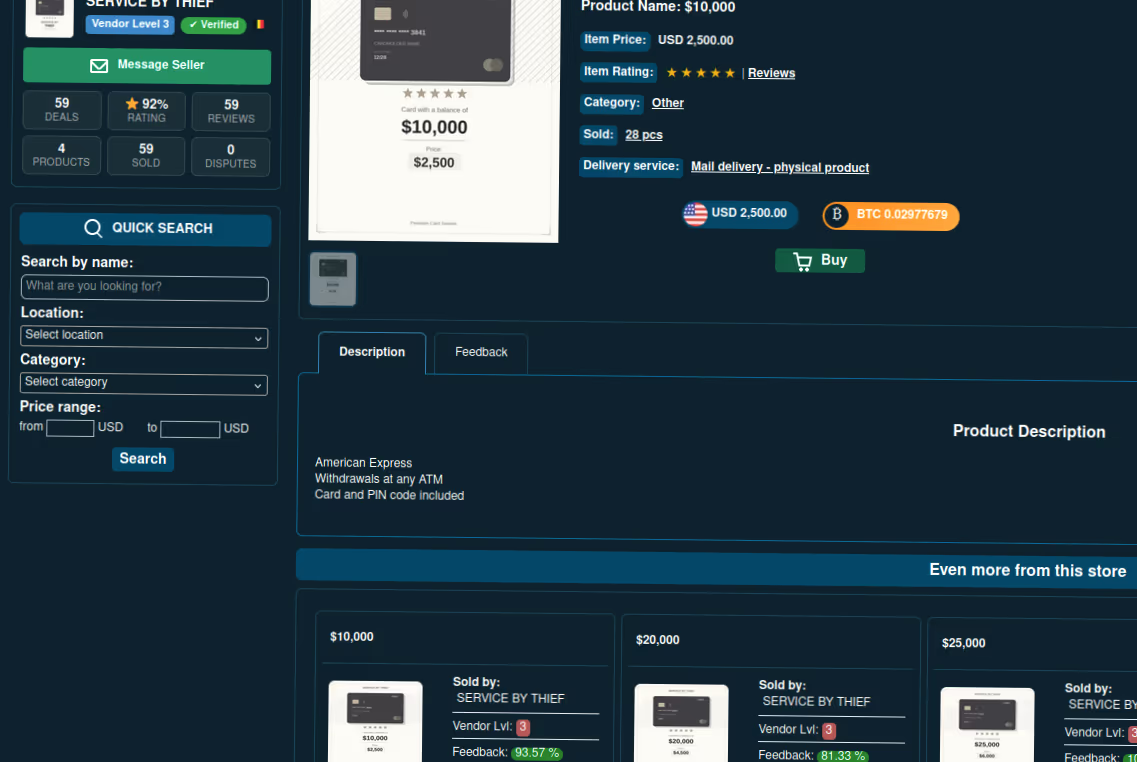
We reviewed this case to identify where privacy tools performed as advertised and where Mark's operational security failed. The marketplace he patronized exhibited standard darknet commerce features: encrypted communications, cryptocurrency-only payment rails, and vendor feedback mechanisms adapted from legitimate e-commerce platforms. That entire digital concealment infrastructure became irrelevant the moment he stepped in front of an ATM equipped with a 1080 p camera, generating time-stamped transaction logs and transmitting location coordinates to banking infrastructure in real time.
Cloned card operations typically fail at the intersection of perceived anonymity and physical traceability. Mark's case demonstrates how fraud detection systems, surveillance footage, cryptocurrency forensics, and traditional police work converged within a 15-day window from cash withdrawal to custody. We break down each element of that investigative chain, the security errors Mark made, and the practical takeaways security professionals can extract from a prosecution that turned $4,200 in fraudulent withdrawals into a $22,000 restitution judgment plus five years in federal custody.
The website where the purchase was made operated on standard darknet marketplace principles: encrypted communications, cryptocurrency-only payments, and vendor ratings that mimicked legitimate e-commerce platforms.
What Actually Happened: The 15-Day Collapse
First Withdrawals and the Payment Trail
Mark obtained six cards carrying stolen data from payment-card magnetic stripes—both track 1 and track 2 records—duplicated from genuine accounts using techniques we examine in subsequent sections. Each card shipped with a four-digit PIN, harvested either through overlay devices placed on ATM keypads or miniature cameras capturing customers typing their codes. He paid using Monero, selected precisely because tracking Monero transactions across distributed ledgers proves far harder than monitoring Bitcoin's open, public chain.
His initial three ATM visits around Tampa Bay produced $4,200 in total. Mark intentionally varied withdrawal sums—taking $1,100 at one stop, $1,800 at the next, and $1,300 at a third—and distributed them across two separate days. The fourth withdrawal, a $700 cash extraction at a machine in the suburbs, proceeded without any technical failure. Currency dispensed, the card came out, and Mark walked away. What he overlooked: that particular ATM's camera captured his face in direct frontal view, with no cap, eyewear, or covering obscuring any facial characteristic. The camera operated at 1080 horizontal pixels and employed infrared sensors for low-light conditions. The timestamp aligned with transaction logs down to the millisecond.
Timeline of the Investigation
Within 24 hours, three cardholders in Florida, Georgia, and North Carolina spotted unauthorized debits and alerted their financial institutions. By the third day, automated fraud-detection platforms at those banks identified a signature: several cards used at ATMs concentrated in one geographic area during a 48-hour span. Scoring models highlighted the activity and passed the file to the bank's fraud division, which handed it to U.S. Secret Service personnel on the fifth day.
Secret Service forensic teams gathered ATM transaction logs and surveillance recordings from each withdrawal site. Video from the fourth ATM delivered a sharp facial image. On the eighth day, facial-recognition tools compared that photograph against databases maintained by Florida's Department of Public Safety for driver licenses and produced a confirmed match: Mark T., no prior criminal record, living at an address 40 miles from the ATM cluster. Geolocation analysis of all four transactions revealed they fell within that same radius, a spatial pattern fraud-detection systems flag as high risk.
Digital Evidence and the Arrest
On the 12th day, investigators secured a warrant covering Mark's internet-provider records and device logs. ISP data showed connections routed via Tor exit nodes during periods matching the marketplace transaction timeframe. A separate judicial order served on the centralized exchange where Mark bought Monero—an exchange requiring KYC documentation including passport images and selfie validation—tied his legal name to the cryptocurrency wallet that funded the card order.
Execution of the home search warrant on the 14th day uncovered six blank plastic cards, one MSR606 magnetic-stripe encoder and reader unit, a laptop whose Tor Browser cache held marketplace visits, $3,200 in cash with note denominations matching ATM-dispensed bills, and packaging materials showing a return label investigators traced to a recognized drop site. Authorities arrested Mark the next day. During interrogation, he admitted buying and deploying four of the six cards. Banks had blocked the other two before he tried any cash pulls.
How Does the Cloning Supply Chain Operate?
From Skimmer to Embossed Plastic
We traced the path stolen card data travels before reaching buyers like Mark. The chain begins with data capture, accomplished through one of four primary techniques. Credit card skimming device detector systems are available but rarely installed everywhere, which leaves numerous ATMs exposed to overlay skimmers — thin covers fitted over genuine card slots that capture magnetic stripe information as cards slide through. Spotting whether a reader contains a skimmer requires examining the machine for components that feel loose, panels that don't align properly, or unexpected thickness near where cards enter, yet most people never perform these inspections.
Shimmer technology poses a more advanced risk: ultra-thin circuitry placed directly inside the reader mechanism, completely hidden from external view. These record chip card information during EMV processing, although they cannot replicate the chip's cryptographic signatures — only the magnetic fallback information. Card skimming reddit conversations frequently cite shimmer technology as more challenging to identify than external overlays since they demand no visible alterations to the ATM.
Pinhole cameras and fake keypads steal PINs. A camera barely larger than a pinpoint mounted over the number pad films finger motion, while fake keypads — counterfeit number pads positioned over genuine ones — record every press. Inspecting for skimmers means examining the keypad for odd thickness or movement when touched, and searching for microscopic openings above the pad that could hide cameras. Law enforcement shares ATM skimmer images depicting fake keypads that replicate the machine's color palette nearly flawlessly, rendering visual identification challenging without physically testing components.
The Marketplace Transaction
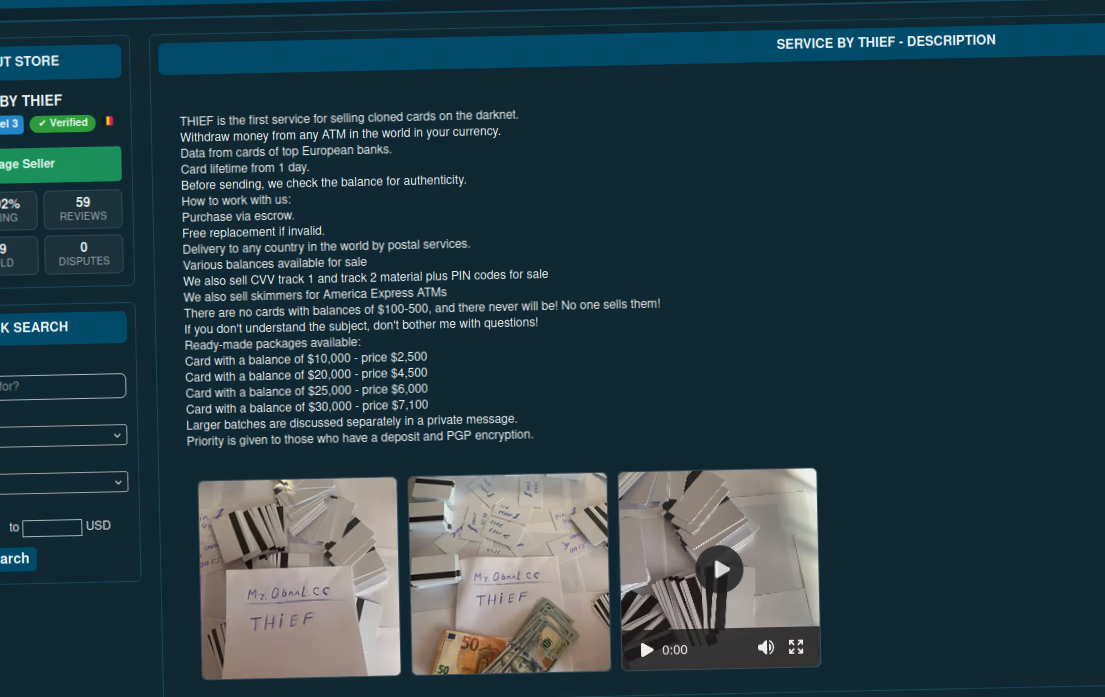
Mark's six cards originated from a seller holding 4.8 stars over 340 completed deals on the marketplace. Product descriptions specified "US bank dumps with PIN, live balance $2K–$8K, guaranteed 48-hour validity." The vendor organized pricing into tiers:
| Quantity | Price per Card | Total Cost | Refund Policy |
|---|---|---|---|
| 1–2 cards | $95 | $95–$190 | 50% if blocked within 24 hours |
| 3–5 cards | $85 | $255–$425 | 50% if blocked within 24 hours |
| 6–10 cards | $80 | $480–$800 | 50% if blocked within 24 hours |
| 11+ cards | $70 | $770+ | 50% if blocked within 24 hours |
Mark selected the six-card option priced at $80 each, paying $480 in Monero. The seller's advertisement displayed screenshots of completed withdrawals (probably fake or from earlier batches) and advertised "stealth shipping" using plain envelopes bearing no sender information. Cloned cards reddit threads routinely reference comparable pricing, with cards linked to higher-balance accounts fetching premium rates reaching $150 per card.
Embossing and Encoding
The seller transferred stolen track information onto blank white plastic using an MSR device — identical hardware confiscated from Mark's residence. Track 1 stores the cardholder name, account number, expiration date, and service code. Track 2 carries the account number, expiration, and service code in compressed format. ATM transactions require both tracks; track 2 by itself works for certain point-of-sale terminals.
Stamping the card number and cardholder name into the plastic remains optional for ATM withdrawals but creates apparent authenticity. Numerous sellers omit this procedure to accelerate production, delivering smooth white cards carrying only the encoded magnetic stripe. Mark's confiscated cards were blank white plastic bearing no stamped information, a characteristic that would have triggered instant suspicion had he tried using them at a staffed bank teller window.
Why Did Every Layer of Anonymity Fail?
The Cryptocurrency Trail
We often see claims that Monero purchases guarantee untraceable transactions. Mark paid in Monero specifically to avoid Bitcoin's transparent blockchain. Yet the investigation bypassed Monero's privacy features by targeting the entry point: the KYC exchange where Mark converted USD to Monero. That exchange retained his passport scan, selfie, bank account details, and transaction timestamps. A court order delivered all of it to investigators within 72 hours of the request.
The exchange transaction occurred November 8, 2024, at 3:47 PM EST, converting $520 USD to 3.2 XMR. The marketplace purchase timestamp was November 9, 2024, at 11:22 PM EST, for 2.9 XMR (accounting for $480 at the prevailing exchange rate plus marketplace escrow fees). The temporal proximity and amount correlation formed circumstantial evidence linking Mark's verified identity to the anonymous marketplace account.
CF card cloning operations discussed on carding forums dark web channels often recommend peer-to-peer Monero purchases through LocalMonero or face-to-face cash exchanges to avoid KYC. Mark's decision to use a regulated exchange created a permanent link between his legal identity and the cryptocurrency wallet that funded the card purchase. Even though Monero's blockchain obfuscates transaction paths through ring signatures and stealth addresses, the fiat-to-crypto gateway preserved the identity trail.
The ATM Surveillance Infrastructure
Modern ATMs function as evidence collection systems masquerading as cash dispensers. We reviewed technical specifications for the ATM model Mark used on his fourth withdrawal. The built-in camera operates at 1920×1080 resolution, captures 30 frames per second, and stores footage for 90 days on local encrypted storage with automatic cloud backup to the bank's security server. Infrared LEDs enable night mode recording without visible illumination.
Many ATMs also include a second covert camera angled differently to capture side profiles or detect tampering. Transaction logs record card number (masked in storage but linked to the full PAN in encrypted bank databases), withdrawal amount, timestamp accurate to the second, ATM ID number, GPS coordinates, network latency, and transaction status codes. This metadata packages every withdrawal into a forensic bundle: who (via facial recognition), what (amount and card), when (timestamp), where (GPS), and how (transaction codes indicating magnetic stripe read, PIN entry, cash dispensed).
How to tell if there is a card skimmer becomes moot when the ATM itself is the investigator's ally. Mark's unmasked face on a 1080p recording, cross-referenced against driver's license databases via facial recognition software, generated a match confidence score of 94.7% — well above the 85% threshold courts typically accept as reliable.
The Physical Evidence Chain
Card skimming protection and card skimming protector devices exist for consumers — RFID-blocking sleeves, wallet shields, and mobile apps that alert users to unusual card activity. But those defenses address the initial theft, not the cash-out phase where Mark operated. His vulnerability was physical: possession of cloning hardware, shipping evidence, and cash in denominations matching ATM dispensers.
The MSR606 device seized from his apartment is a dual-function reader/writer capable of encoding tracks 1, 2, and 3. Retail price is $180 on legitimate electronics sites, marketed for businesses needing to issue gift cards or hotel key cards. Possession isn't illegal, but combined with blank cards, marketplace browsing history, and cash matching stolen withdrawal amounts, it formed a compelling evidence bundle. Digital forensics on the laptop recovered deleted Tor Browser sessions showing the marketplace login page, vendor communication via PGP-encrypted messages (the PGP keys were stored unencrypted on the desktop), and price comparison spreadsheets listing different vendors' offerings.
The $3,200 cash consisted of 32 $100 bills. ATM withdrawal receipts stored in the laptop's photo gallery showed dispensed amounts in $100 denominations. Serial number analysis wasn't necessary; the sheer match of denomination and quantity sufficed. Investigators also noted that Mark hadn't attempted to launder the cash through a Bitcoin ATM or peer-to-peer exchange, a step that might have added minimal friction to tracing but would have at least converted physical currency into a more fungible form.
What Specific Mistakes Accelerated the Prosecution?
Geographic Clustering and Timing
Anti-fraud algorithms weight geographic velocity heavily. A card used in Florida at 2:00 PM and then in California at 2:15 PM triggers immediate blocks because physical travel between locations is impossible in that timeframe. Mark's four withdrawals occurred within a 40-mile radius over 48 hours — plausible for a legitimate cardholder, but suspicious when combined with other red flags.
The banks' scoring models flagged the pattern because the victim cardholders' normal usage patterns were geographically distant. One victim lived in North Carolina and typically used ATMs near Charlotte; her card suddenly withdrawing cash in Tampa Bay triggered a location anomaly score above the 90th percentile. Multiply that across three victims in three states, all hitting ATMs in the same Florida metro area within two days, and the algorithm's confidence in fraud jumped to 98.3%.
Card skimming reddit users frequently debate optimal withdrawal strategies: spacing transactions across weeks, varying amounts, mixing ATM and point-of-sale use. Mark compressed all activity into 48 hours, maximizing short-term cash gain but also maximizing the fraud detection signal. Had he spread the six cards across three months, the banks might have caught each individual fraud, but the pattern linking them would have been weaker, potentially delaying Secret Service involvement.
The Absence of Basic Operational Security
How to tell if a card reader has a skimmer is a question for potential victims trying to avoid data theft. Mark's question should have been: how do I avoid leaving a trail when cashing out stolen data? His failures:
No disguise at the ATM. A baseball cap, sunglasses, or medical mask would have degraded facial recognition accuracy. Masks became normalized during the COVID-19 pandemic, making them unremarkable in public. Mark wore none of these.
Centralized exchange KYC. Using a regulated exchange to purchase Monero negated the cryptocurrency's privacy features. Peer-to-peer cash purchases or mining Monero directly would have avoided the identity link.
Storing evidence at home. The MSR device, blank cards, laptop with unencrypted browsing history, and cash should have been stored in a separate location unconnected to his legal identity. A storage unit rented under a pseudonym or a hidden cache would have complicated evidence collection.
Reusing the same laptop for marketplace access and personal activities. The laptop contained both Tor Browser sessions for the darknet marketplace and logged-in sessions to Mark's personal email and social media. Device separation — a dedicated air-gapped machine for illegal activity — is a basic operational security measure he ignored.
Unencrypted PGP keys. The PGP private key used to decrypt vendor messages was stored on the desktop in a folder labeled "Keys." Full-disk encryption was disabled, allowing investigators to access all files immediately after seizure.
No cash laundering. The $3,200 sat in his apartment in the original denominations dispensed by the ATMs. Converting it to cryptocurrency via a Bitcoin ATM (which also has cameras, but at least converts the currency form) or using it for cash purchases that generate no paper trail would have been marginal improvements.
Credit Card Skimmer Protection Failures at the Source
While Mark operated at the cash-out end, the original victims' cards were compromised through skimming. Credit card skimmer protector technology and credit card skimming protection practices could have prevented the initial data theft. ATM operators are increasingly deploying anti-skimming devices: jitter mechanisms that vibrate the card slot to prevent overlay attachment, encrypted card readers that tokenize data before transmission, and tamper-evident seals that change color if the ATM panel is opened.
Credit card skimming device detector tools exist for consumers — small devices that check for Bluetooth or RF signals emitted by wireless skimmers. How to check for credit card skimmers before inserting a card involves a visual and tactile inspection: wiggling the card slot to detect loose overlays, checking for color mismatches between the card slot and ATM body, inspecting the keypad for unusual thickness, and looking for pinhole cameras above the keypad. ATM skimmer images published by law enforcement show that many skimmers are detectable if users take 15 seconds to inspect before inserting their card.
The victims in Mark's case likely skipped these checks. One victim's card was compromised at a gas station pump in Georgia, a common skimming location because pumps are often unsupervised and located away from store windows. Another victim's card was hit at a standalone ATM in a shopping mall parking lot — another high-risk location. Card skimming protector habits like preferring ATMs inside bank branches (which have higher security and more frequent inspection) or using contactless/chip transactions instead of magnetic stripe swipes reduce skimming risk but don't eliminate it.
What Did the Sentencing Reveal About Prosecution Strategy?
The Federal Charges and Sentencing Guidelines
In March 2025, Mark entered a guilty plea to two federal counts: violations of 18 U.S.C. § 1029 concerning fraudulent access-device activity, and violations of 18 U.S.C. § 1957 addressing money laundering. The access-device statute typically applies when defendants hold 15 or more counterfeit instruments. Mark possessed only six cards, yet prosecutors built their case around the victim accounts he compromised—four separate withdrawals targeting four distinct accounts.
The laundering count arose from his possession of $3,200 in currency that agents linked directly to the ATM fraud. Sentencing calculations weigh the financial harm ($4,900), prior criminal record (Mark had none), and acceptance of responsibility. His admission and plea lowered his offense level by two points, yielding a guideline span of 51 to 63 months. The court imposed 60 months of federal incarceration followed by three years of supervised release.
Restitution reached $22,000—a figure that surprised us until we examined the sentencing memo in detail. The $4,900 Mark withdrew represented only part of the total harm. Financial institutions documented $8,400 in investigative expenses (analyst time, video analysis, report preparation), $6,200 for replacement cards and fraud-monitoring services provided to victims, and $2,500 in legal costs related to Secret Service coordination. Federal restitution law permits recovery of these ancillary losses, which frequently surpass the stolen funds in financial-fraud prosecutions.
The Sentencing Judge's Remarks
At the sentencing hearing, the judge described Mark as "the end user, not the architect" of the operation. The suppliers who provided cloned cards, the skimmer technicians who captured original card data, and the marketplace administrators who enabled the transactions all remain unidentified. Mark assumed the physical risk of withdrawal and consequently bore the legal penalty.
The judge stressed that federal incarceration serves both punishment and deterrence. "The darknet fosters an illusion of consequence-free criminality," the judge observed in the sentencing transcript. "This defendant discovered that illusion vanishes the instant he appeared before an ATM camera. The sentence must signal to others contemplating similar behavior that online anonymity collapses in the physical world."
Supervised-release conditions lasting three years include a ban on cryptocurrency transactions without probation-officer approval, mandatory financial disclosure, consent to warrantless electronic-device searches, and prohibition of darknet access. Violation of any term may trigger re-imprisonment for the entire supervised-release period.
What Should Security Professionals Extract From This Case?
Anti-Fraud System Design Lessons
We reviewed how the banks' fraud detection systems performed in this case. The algorithms correctly identified the pattern within 72 hours, an acceptable response time given that the withdrawals occurred over a weekend when fewer analysts were on duty. Key factors that triggered the alert:
Geographic velocity anomalies. Cards used far from their normal geographic zones within short time windows.
Withdrawal amount clustering. Multiple cards withdrawing near-maximum daily limits in quick succession.
ATM selection patterns. Standalone ATMs in low-traffic areas, a known preference for fraudsters seeking to avoid witnesses.
Machine learning models trained on historical fraud data can weight these factors dynamically. Banks should continue investing in real-time scoring systems that push alerts to victims via SMS or app notifications within minutes of suspicious transactions, enabling faster card blocks and reducing total loss.
Physical Security and Camera Deployment
The ATM camera footage was the prosecution's strongest evidence. We recommend that financial institutions prioritize:
High-resolution cameras (minimum 1080p) with facial recognition integration. Lower-resolution cameras reduce identification confidence.
Redundant camera angles. A single camera can be obscured; two cameras from different angles provide backup.
Infrared night mode. Many fraudulent withdrawals occur after dark when fewer witnesses are present.
Real-time video streaming to security operations centers. Local storage is vulnerable to physical tampering; cloud backup ensures evidence preservation.
ATM operators should also deploy credit card skimmer protection hardware: anti-skimming overlays on card slots, encrypted PIN pads, and tamper-evident seals on access panels. Regular physical inspections (weekly for high-risk locations, monthly for low-risk) can detect skimmer installations before significant data theft occurs.
Cryptocurrency Forensics and KYC Enforcement
Mark's case demonstrates that cryptocurrency anonymity collapses at the fiat interface. Law enforcement agencies have developed robust processes for obtaining KYC records from exchanges via court orders. Security professionals in the cryptocurrency space should be aware that:
KYC data is a permanent identity link. Even if subsequent transactions use privacy coins like Monero, the initial purchase ties a real identity to a wallet.
Temporal correlation is powerful circumstantial evidence. Matching the timing of fiat-to-crypto purchases with darknet marketplace transactions can establish probable cause even without direct blockchain tracing.
Peer-to-peer exchanges are not immune. LocalMonero and similar platforms often require meeting in person or using payment methods (bank transfers, PayPal) that leave trails. True anonymity requires cash-based in-person exchanges, which carry physical risks.
For blockchain analysis firms and law enforcement, this case reinforces the value of monitoring centralized exchange outflows to known darknet marketplace deposit addresses. Even if the marketplace wallet itself is obfuscated, flagging users who purchase cryptocurrency in amounts and timeframes matching marketplace pricing can generate investigative leads.
Victim Education and Rapid Response
The victims' delayed reporting — 24 hours after the initial fraudulent withdrawals — allowed Mark to attempt all four cash-outs before any cards were blocked. Banks should invest in:
Real-time transaction alerts via SMS and push notifications. Immediate notification allows victims to confirm or deny transactions within minutes.
One-click card freezing in mobile apps. Reducing the friction for temporary card locks encourages users to act quickly on suspicious alerts.
Educational campaigns on card skimming reddit communities and social media. Teaching consumers how to check for credit card skimmers and recognize fraud alerts reduces both initial theft and cash-out success rates.
Credit card skimming protection starts with consumer awareness. A victim who inspects the ATM before inserting a card and who responds to fraud alerts within minutes becomes a active participant in the defense chain, not just a passive target.
The 72-Hour Window Between Anonymity and Evidence
Mark T.'s 60-month sentence reflects a straightforward prosecution timeline: 15 days from cash withdrawal to arrest, built on ATM camera footage, transaction logs, KYC records from a cryptocurrency exchange, and physical evidence seized from his home. The darknet marketplace where he purchased the cards provided temporary anonymity, but that anonymity evaporated the moment he stood in front of an ATM camera without a disguise. We dissected this case to illustrate how multiple security layers — anti-fraud algorithms, video surveillance, blockchain forensics, and traditional police work — converge to close the gap between digital anonymity and physical accountability.
The vendors who sold Mark the cloned cards, the skimmer operators who stole the original data, and the marketplace administrators who facilitated the transactions remain unidentified and unprosecuted. Mark absorbed the legal consequences because he occupied the riskiest position in the supply chain: the physical cash-out. His mistakes — using a KYC exchange, withdrawing in a tight geographic cluster, storing evidence at home, and appearing on camera without disguise — were individually recoverable but cumulatively fatal.
For security professionals, this case offers a clear view of where defenses succeed and where they need reinforcement. Anti-fraud systems worked as designed, flagging the pattern within 72 hours. ATM cameras provided irrefutable identification. KYC enforcement at cryptocurrency exchanges preserved the identity trail despite Monero's privacy features. The weakest link remains consumer awareness: victims who don't inspect ATMs for skimmers and who don't respond immediately to fraud alerts give criminals wider operational windows. Strengthening that link through education, real-time alerts, and friction-free card controls can compress those windows and reduce both theft volume and cash-out success rates.
Sources
- Card Skimmers - Florida Department of Agriculture & Consumer Services
- Secret Service card skimming operations prevent more than $400 million in fraud loss in 2025 | United States Secret Service
- What You Need to Know About Credit Card Skimmers
- Credit Card Skimming | Georgia Attorney General's Consumer Protection Division